
Learn Sets, Frozensets in Python: Day 6 Guide

I'm Archana, pursuing Graduation in Information technology and Management. I'm a fresher with expertise in Python programming. I'm excited to apply my skills in AI/ML learning , Python, Java and web development. Looking forward to collaborating and learning from industry experts.
Introduction:
Welcome to Day 6 of my Python journey!
Today, I ventured into the realm of sets, frozensets .
These concepts are essential for efficient data manipulation and storage.
class set :
BASIC :
. set is a predefined class in python.
. to get the mannuel of set class, >> help ( set )
. how to create the object of set class,
obj = set ()
print ( obj , type ( obj ))
obj = set ( { 10, 20, 30 } )
print ( obj , type ( obj ) )
obj = { 10, 20, 30, 40 }
print ( obj , type ( obj ))

. set object is represented by {}
. set does not store the data as per the insertion order.
. set is an unordred data structure.
. set does not support duplicate element.
. set is a collection of similar or dissimilar types of elements.
. it is a iterable object .
. set object is mutable object.
. we can modify a set object in future as per the demand of situation.
. set object supports item assignment and item deletion.
INDEXING
. subscript operator is not supported with set object.
object [ index ]
. indexing mechanism is not supported with set object.
operation with set object :
UNION
INTERSECTION
DIFFERENCE
SYMETRIC_DIFFERENCE
OPERATORS :
arithmatic
- : difference
bitwise
& : intersection
| : union
^ : symmetric_difference
membership
in not in
is is not
deletion
not supported
slicing not supported bcz set does support indexing mechanism
FUNCTIONS :
len ()
sum ()
max ()
min ()
sorted () no sorted because index is not aval for set object
METHOD :
UNION
union ()
update ()
INTERSECTION
intersection ()
intersection_update ()
DIFFERENCE
difference ()
difference_update ()
SYMMETIRC_DIFFERENCE
symmetric_difference ()
symmetric_difference_update ()
INSERTION
add ()
DELETION
pop () : remove arbitrary element
remove () : remove a specific element, but on failuer raise KeyError exception
discard () : remove a specific element, on faileruer return None
clear () : delete all elements
IS METHOD
issuperset ()
issubset ()
etc
bytes Data Type:
bytes data type represents a group of byte numbers just like an array.
x = [10,20,30,40]
b = bytes(x)
Conclusion 1:
The only allowed values for byte data type are 0 to 256. By mistake if we are trying to provide any other values then we will get value error.
Conclusion 2:
Once we creates bytes data type value, we cannot change its values,otherwise we will get TypeError.
it is a immutable object
x=[10,20,30,40]
b=bytes(x)
#b[0]=100 #TypeError: 'bytes' object does not support item assignment
bytearray Data type:
bytearray is exactly same as bytes data type except that its elements can be modified.
it is a mutable object
example :
x=[10,20,30,40]
b = bytearray(x)
print (b) x[1] = 200
print (b)
Frozenset :
Frozenset is an immutable (unchangeable) version of a set in Python.
It provides a way to store unique elements without duplicates, and its immutability makes it useful for various applications.
Key Features:
Immutable: Cannot be modified after creation.
Unordered: Elements stored without any particular order.
Unique elements: No duplicates allowed.
Hashable: Can be used as dictionary keys.
Creating a Frozenset:
From a list
my_list = [1, 2, 2, 3, 4]
my_frozenset = frozenset(my_list)
From a set
my_set = {1, 2, 2, 3, 4}
my_frozenset = frozenset(my_set)
Directly
my_frozenset = frozenset([1, 2, 3, 4])
Frozenset Operations:
Union: my_frozenset | other_frozenset
Intersection: my_frozenset & other_frozenset
Difference: my_frozenset - other_frozenset
Symmetric Difference: my_frozenset ^ other_frozenset
Subset: my_frozenset.issubset(other_frozenset)
Superset: my_frozenset.issuperset(other_frozenset)
Use Cases:
Dictionary keys
Set operations
Data deduplication
Thread-safe data structures
Mathematical operations (e.g., finding prime numbers)
Graph algorithms
Benefits:
Thread-safe
Memory-efficient
Improved code readability
Faster execution (due to immutability)
Common Methods:
add(): Not supported (immutable)
remove(): Not supported (immutable)
union(): Returns a new frozenset with combined elements
intersection(): Returns a new frozenset with common elements
difference(): Returns a new frozenset with unique elements
issubset(): Checks if all elements are present in another frozenset
issuperset(): Checks if all elements of another frozenset are present
Example Code:
fs1 = frozenset([1, 2, 3])
fs2 = frozenset([3, 4, 5])
print(fs1 | fs2) # Union print(fs1 & fs2) # Intersection
my_dict = {fs1: "value"}
print(my_dict[fs1]) # Dictionary key
Best Practices:
Use frozenset when immutability is required.
Avoid modifying frozenset instances.
Use set when mutability is necessary.
By mastering Frozenset, you'll write more efficient, readable, and thread-safe code in Python!
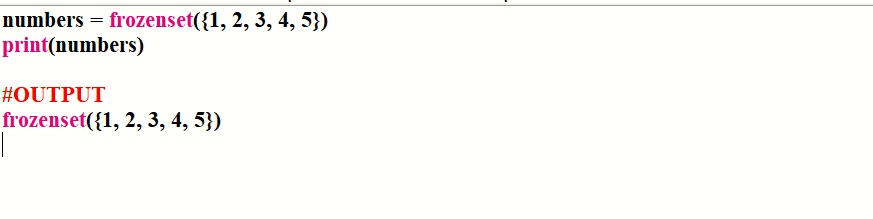
numbers = frozenset({1, 2, 3, 4, 5})
print(numbers)
# Output: frozenset({1, 2, 3, 4, 5})
challenges:
Understanding set, frozenset operations.
Handling coding errors.
Resources:
Official Python Documentation: Sets, Frozensets
W3Schools' Python Tutorial: Sets, Frozensets
Scaler's Python Course: File Input/Output
Goals for Tomorrow:
- Explore String.
Conclusion:
Day 6 was a success!
Sets, frozensets are now under my belt.
What are your favorite Python libraries for data manipulation? Share in the comments below.
Connect with me:
LinkedIn : [ https://www.linkedin.com/in/archana-prusty-4aa0b827a/ ]
GitHub: [ https://github.com/p-archana1 ]
Join the conversation:
Share your own learning experiences or ask questions in the comments.
Next Post: Day 7: we'll learn String.
Happy learning!
THANK YOU!!


